| China’s Farthest Offshore Wind Power Project Connected to Grid at Full Capacity |
| updated: 2025-12-25 views: font-size:【big middle small】 |
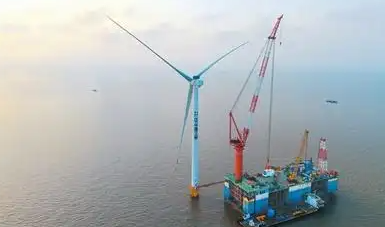
On December 15, with the successful commissioning of the last wind turbine, the Three Gorges Jiangsu Dafeng 800MW Offshore Wind Power Project—China’s farthest offshore wind power project—was fully connected to the power grid. This marks another major breakthrough in China’s advancement of offshore wind power into the open and deep sea areas. Invested and constructed by China Three Gorges Corporation, the project is among the first batch of benchmark projects for grid-connected offshore wind power at parity in Jiangsu Province. Located in the Yellow Sea waters northeast of Dafeng District of Yancheng, the project consists of four sites, equipped with 98 wind turbines with a total installed capacity of 800MW. Supporting facilities include two 200MW offshore substations, one 400MW offshore substation and one offshore rescue platform. Among them, the H8-1 site has a central point 80 kilometers away from the shore and a farthest point 85.5 kilometers offshore, setting a new record for the farthest distance of China’s offshore wind power projects from the shore. The project has independently developed and built China’s first offshore substation equipped with a meteorological radar. Through a refined marine meteorological monitoring system, it accurately captures key meteorological data such as wind speed and direction, providing real-time support for the optimal dispatch of wind turbines and the safe operation and maintenance of equipment. Meanwhile, its in-depth coordination with the wind farm operation control system has improved the power generation efficiency and operational stability of the wind farm, setting an example for the early warning of meteorological disasters in China’s offshore wind power clusters, marine fishery and maritime shipping. In addition, the project has put a 13.6MW wind turbine into operation, breaking the record for the single-turbine capacity of offshore wind turbines in Jiangsu’s sea areas. It is understood that the project is expected to generate over 2.8 billion kilowatt-hours of electricity annually, which can meet the daily electricity needs of 1.4 million households. This is equivalent to saving about 860,000 tons of standard coal and reducing carbon dioxide emissions by approximately 2.37 million tons, injecting a steady stream of clean energy into ensuring energy supply and promoting green and low-carbon development in the Yangtze River Delta region. |